


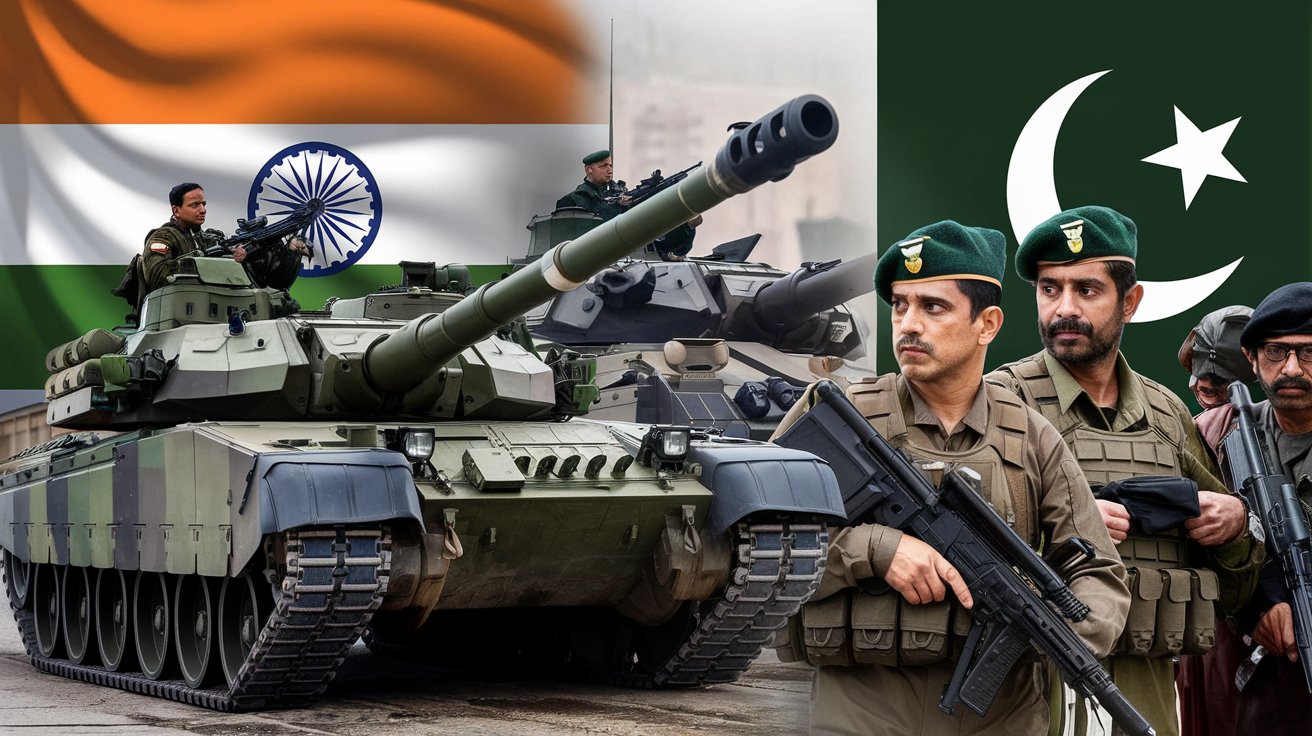
In April 2025, tensions between India and Pakistan reached a critical juncture following a deadly terrorist attack in Pahalgam, Kashmir, which claimed the lives of 26 tourists, most of them Hindu. The terrorists from The Resistance Front, an offshoot of Pakistan-based and ISI-backed terror outfit Lashkar-e-Taiba, reportedly asked for the religion of the victims before killing them.
Islamabad has denied involvement and is calling for a neutral investigation. In response, both nations expelled diplomats; India suspended a longstanding water-sharing Indus Water Treaty and closed their airspaces. Military skirmishes erupted along the Line of Control (LoC), reminiscent of past conflicts, in a violation of the ceasefire.
This escalation shows the fragile peace between these nuclear-armed neighbours and how quickly things come falling down like a house of cards. Both India and Pakistan have been modernising their armed forces, with India enhancing its naval and air power and Pakistan strengthening its nuclear deterrent and missile systems.
Why This Matters
Military balance between India and Pakistan remains central to South Asian stability. Differences in budgets, force structures, and strategic priorities directly influence deterrence, crisis management, and the risk of escalation. A clear comparison helps move beyond rhetoric to understand actual capabilities and limitations on both sides.
India and Pakistan, with their deeply entrenched historical disputes, particularly over the Kashmir valley, have continued to focus heavily on strengthening their defence capabilities. This comprehensive comparison of the military capabilities of India and Pakistan aims to shed light on how these two neighbouring countries have shaped their armed forces and their potential military power.
Historical Context and Military Buildup
India and Pakistan’s military and conflict history is deeply rooted in the partition of 1947, which led to the creation of Pakistan and an immediate legacy of conflict. The Kashmir dispute, which remains unresolved to this day, became the central issue that has driven military confrontations between the two. Since their inception, both countries have focused heavily on military preparedness, not only as a means of deterrence but as a reflection of their national security concerns.
India, with its larger landmass and population, has always sought to project itself as a regional power, and its military policies have mirrored this ambition. Pakistan, in contrast, has focused on its military capabilities as a counterbalance to India, driven largely by a perception of India’s regional dominance and the historical enmity that has shaped much of its defence posture.
Military Strength
India boasts one of the largest and most technologically advanced militaries in the world. With approximately 1.4 million active-duty personnel and a reserve force numbering over 2 million, India’s military is substantial. It is divided into the Indian Army, the Indian Navy, and the Indian Air Force (IAF). India’s military also operates a robust paramilitary force that includes units dedicated to border control, law enforcement, and counterinsurgency operations.
Pakistan, while smaller in size, has a capable military with around 654,000 active-duty personnel, making it the 14th largest military in the world in terms of manpower. The Pakistani military is heavily geared toward defensive capabilities due to its rivalry with India. Pakistan also maintains a large number of reserve personnel, which allows it to quickly mobilise forces during periods of heightened tension.
Budget Allocation and Spending Priorities
India’s defence budget is one of the largest globally. In the fiscal year 2023-24, India’s total defence expenditure was approximately $45 billion, making it the fourth-largest military spender globally. India’s defence budget is focused on modernising its armed forces, with a particular emphasis on enhancing its air and naval capabilities. The Indian Air Force, which has invested in cutting-edge fighter jets such as the Rafale, and the Navy, which is focused on expanding its submarine fleet, receive substantial portions of the defence budget.
A significant portion of India’s budget is also allocated to strategic nuclear forces, given the country’s nuclear deterrence posture. The Indian government has prioritised the development of the Agni-class missiles, which are part of its long-range nuclear delivery systems, and continues to invest in improving the range and accuracy of its nuclear arsenal.
In contrast, Pakistan’s defence budget for 2023-24 stood at around $12 billion, notably lower than India’s. But Pakistan’s military spending has historically been highly focused on maintaining a large and capable army and air force, as well as its nuclear capabilities. Pakistan’s reliance on its nuclear arsenal for deterrence against India is a strategic consideration, and this factor influences its defence budget. The Pakistani military also maintains a robust counterterrorism and internal security force, reflecting the country’s longstanding issues with insurgency and militancy.
Nuclear Capabilities
Both India and Pakistan are nuclear powers, with a big stress on nuclear deterrence in their defence doctrines. India conducted its first nuclear test in 1974, followed by the successful testing of a thermonuclear device in 1998. India’s nuclear arsenal is believed to consist of around 150 to 160 nuclear warheads, with a variety of delivery mechanisms, including land-based missiles, aircraft, and submarines. The Indian government has adopted a “No First Use” (NFU) policy, meaning it will only use nuclear weapons in retaliation for a nuclear attack. It still focuses on long-range and capable delivery systems as its own deterrent against China.
Pakistan, also a nuclear-armed state since 1998, has a somewhat different nuclear doctrine. Pakistan maintains a policy of nuclear ambiguity and has refused to adopt a no-first-use stance. The country is believed to possess around 160 to 170 nuclear warheads, with an emphasis on short-range tactical nuclear weapons that could be used in conventional warfare. Pakistan’s nuclear posture is mainly focused on deterring India from launching a full-scale conventional attack, given the asymmetry in their conventional military forces.
Air and Naval Power
India has superbly scaled in modernising its air and naval forces in recent years. Even though it is not at par with China, for Pakistan, it is more than enough. The Indian Air Force is equipped with a range of advanced multirole fighter jets, including the French Rafale, Russian Su-30MKI, and the domestically produced HAL Tejas. The IAF also operates a large fleet of transport and surveillance aircraft, with an increasing focus on unmanned aerial vehicles (UAVs) for surveillance and reconnaissance.
India’s Navy is also expanding rapidly, with a growing number of aircraft carriers, destroyers, and submarines. The Indian Navy operates the INS Vikramaditya, a Soviet-era aircraft carrier, and is expected to commission the INS Vikrant, a domestically built carrier. India’s submarine fleet includes both nuclear-powered and conventionally powered vessels, with the addition of nuclear-capable submarines that form a part of India’s nuclear triad.
Pakistan, in comparison, has a smaller air force and navy, but both branches are highly capable. The Pakistan Air Force operates a fleet of JF-17 Thunder fighters, developed in collaboration with China, as well as F-16 fighter jets from the United States. Pakistan’s air force has focused on maximising the capabilities of its existing fleet while gradually introducing newer technologies, such as advanced radar systems and UAVs.
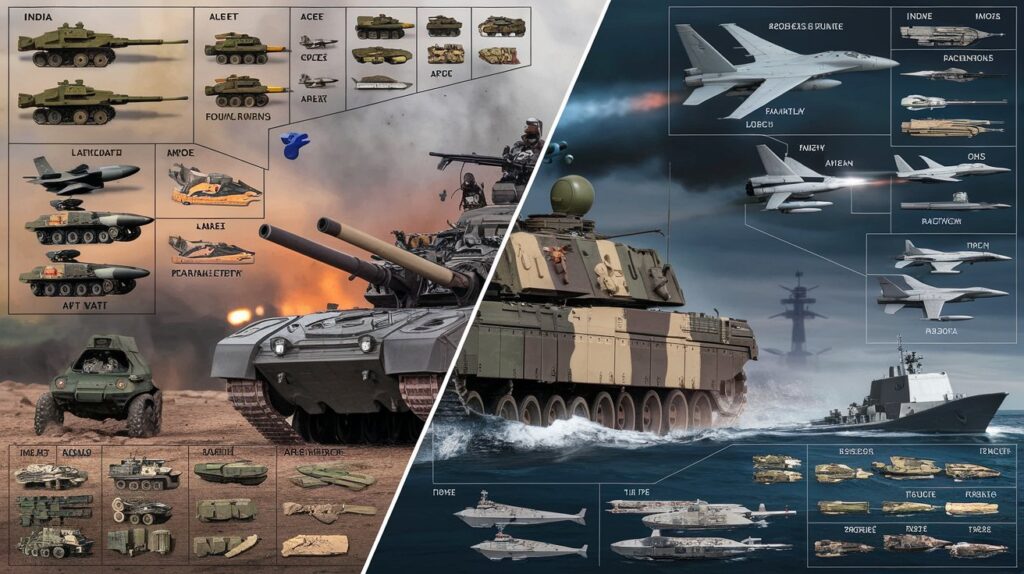
The Pakistan Navy operates a smaller fleet of surface combatants, including frigates, corvettes, and submarines. While Pakistan does not possess aircraft carriers, it has a big submarine fleet, including nuclear-powered submarines, which play a critical role in maintaining its deterrent capability.
Counterinsurgency and Conventional War
India’s land forces are the largest in the region, with close to 1.2 million soldiers. The Indian Army is primarily geared towards conventional warfare, particularly in the context of its ongoing rivalry with Pakistan. India’s focus has been on modernising its land forces, introducing advanced artillery systems, tanks, and air defence systems. The Indian Army also plays a serious role in counterinsurgency operations, especially in regions like Jammu and Kashmir, where insurgent activities have been a longstanding issue.
Pakistan’s military, while smaller in size, has a highly effective and well-trained army. The Pakistan Army has focused on maintaining a significant presence along its western and eastern borders. They also maintain a significant reserve force, which could be mobilised in times of crisis. The Pakistan administration has been deeply involved in using terrorism and insurgency operations, especially against India and sometimes on the Afghanistan border.
Strategic Alliances
India and Pakistan have distinct strategic alliances that shape their military policies. India, as a member of various international forums such as the United Nations and the Shanghai Cooperation Organisation, has cultivated strong defence relationships with countries like the United States, Russia, and Israel. India’s growing military ties with the United States, including defence sales and joint exercises, have become an important part of its strategy to balance China’s growing influence in the region.
Pakistan, on the other hand, maintains close ties with China, which has provided Pakistan with advanced military technologies, including JF-17 fighter jets and nuclear-capable missile systems. Pakistan’s partnership with China is also supported by the China-Pakistan Economic Corridor (CPEC), a strategic initiative that strengthens economic and military ties between the two countries. Pakistan continues to maintain strong military relationships with Saudi Arabia and other Gulf countries, which provide both financial and military support.
Recent Incidents and Military Tensions
The ongoing tension between India and Pakistan has been marked by several military skirmishes, particularly in Kashmir. One of the biggest incidents occurred in February 2019 when a suicide bombing killed 40 Indian CRPF personnel in Pulwama, Kashmir. India blamed Pakistan-based militant groups for the attack, which led to Indian airstrikes on a militant training camp in Balakot, Pakistan. This marked the first time in decades that Indian forces had crossed the Line of Control (LoC) to conduct airstrikes within Pakistan.
The Future
India and Pakistan’s defence capabilities continue to evolve, with each nation focused on strengthening its military to address both conventional threats and non-traditional security concerns. While India has prioritised modernisation and strategic partnerships with major global powers, Pakistan has focused on maintaining a credible deterrent against India, with an emphasis on nuclear capabilities and asymmetrical warfare.
The future of their military rivalry will likely be influenced by their economic trajectories, domestic political stability, and the broader geopolitical environment, including the rise of China and shifting global alliances. As both nations continue to invest heavily in their military forces, the prospect of a military conflict remains a significant concern for regional stability, underscoring the need for continued diplomacy and conflict resolution efforts in the region.