

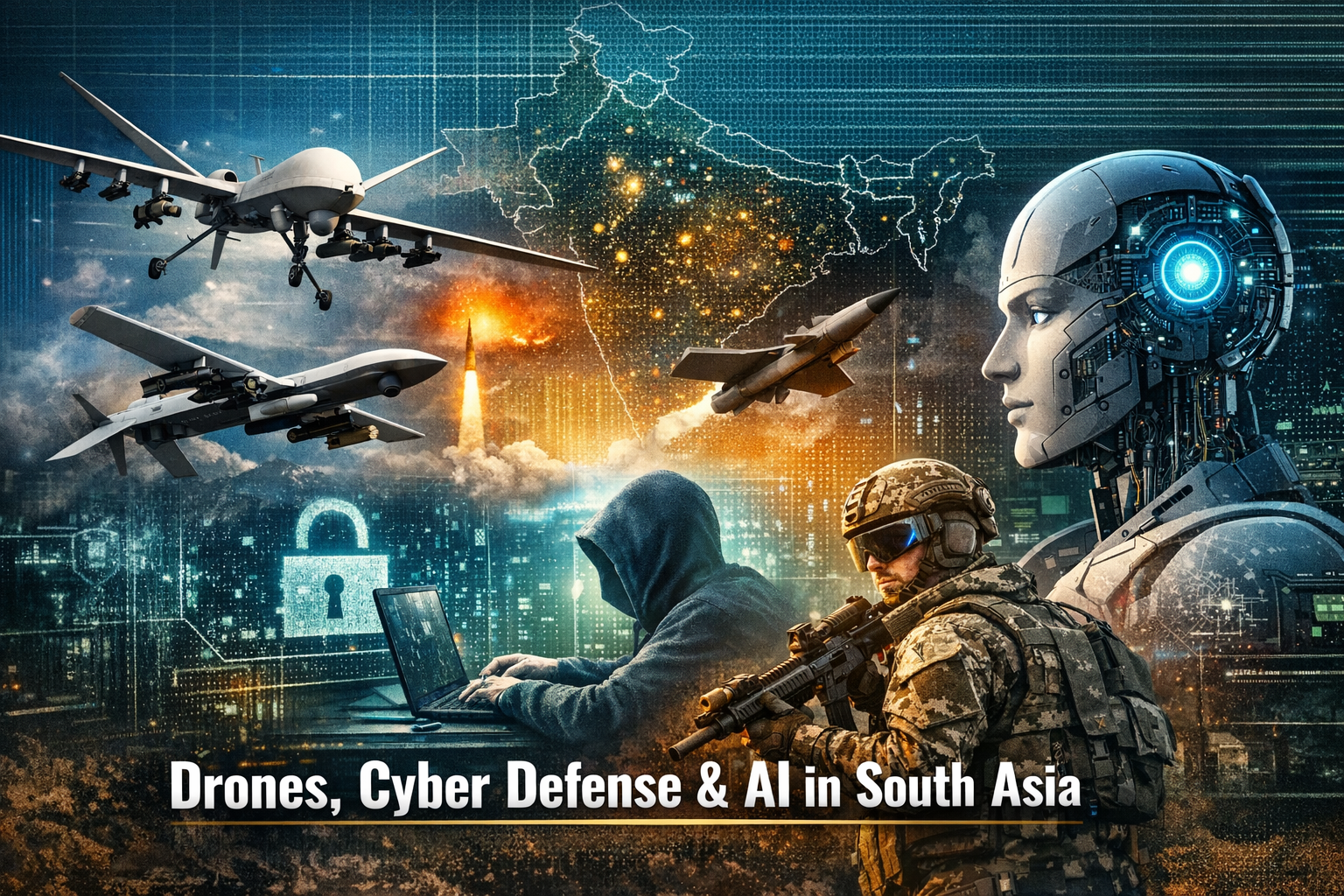
South Asia, particularly India, is undergoing a structural transformation in military doctrine driven by rapid advances in defence technology. Drones, cyber defence capabilities, and artificial intelligence in military operations are reshaping how regional powers approach deterrence, surveillance, escalation control, and force modernisation. The shift is not cosmetic. It reflects a deeper transition from platform-centric warfare to network-centric operational ecosystems built around data, automation, and digital resilience.
The regional security environment, characterised by contested borders, nuclear deterrence frameworks, hybrid threats, maritime competition, and persistent grey-zone activity, has accelerated investment in emerging military technologies. Rather than expanding force size alone, South Asian militaries are increasingly investing in systems that extend situational awareness, compress decision-making timelines, and enable precision engagement across domains.
Drone warfare, cyber defence infrastructure in India and Pakistan, and AI-driven battlefield analytics are no longer peripheral developments. They are becoming central to how military power is structured, signalled, and sustained.
Drone Warfare in South Asia: Evolution, Capabilities and Strategic Impact
What Types of Military Drones Are Used in South Asia?
India fields indigenous systems like Netra and Rustom for tactical and ISR missions, and operates MQ‑9 Reaper for long‑endurance strategic coverage. It also employs Harop and Harpy loitering munitions, used prominently during the 2025 India‑Pakistan crisis. Pakistan deploys advanced armed drones such as the Bayraktar TB2, CAIG Wing Loong II, and tactical Warmate munitions. These platforms support reconnaissance, border monitoring, precision strikes, and suppression of enemy air defences, reflecting the region’s shift toward continuous aerial surveillance and escalatory drone warfare dynamics.
Tactical UAVs provide short-range reconnaissance for frontline units and artillery spotting. Medium Altitude Long Endurance systems conduct sustained border monitoring and maritime patrol. High Altitude Long Endurance platforms extend strategic ISR coverage over vast terrain, including mountainous and coastal regions.
Loitering munitions represent a hybrid evolution, combining surveillance capability with terminal strike functionality. Armed combat UAVs further expand stand-off precision engagement capacity. The diversity of platforms reflects an operational emphasis on continuous observation rather than episodic reconnaissance.
How Do Surveillance and Combat Drones Differ in Regional Doctrine?
Despite global attention on armed drones, surveillance remains the dominant doctrinal function in the region. Persistent ISR coverage helps monitor infiltration routes, observe ceasefire lines, track troop mobilisation, and maintain maritime domain awareness in the Arabian Sea and Bay of Bengal. The broader force structure implications are explored in our detailed India–Pakistan military comparison.
Combat drones and loitering munitions provide escalation flexibility. They enable limited precision engagement without risking pilots, potentially lowering tactical thresholds while retaining strategic signalling control. The distinction between surveillance and strike roles influences both deterrence posture and crisis management.
How Are Indigenous and Imported Drone Programs Expanding?
Both India and Pakistan combine domestic drone development with selective foreign procurement. India has accelerated domestic development through DRDO projects such as the Rustom series and Netra, reflecting a push to reduce reliance on foreign suppliers and tailor systems to local terrain and border‑security needs. Pakistan similarly integrates UAVs into its modernization efforts but depends more heavily on foreign platforms, operating imported systems like the Bayraktar TB2 and China’s Wing Loong II to rapidly enhance its strike and surveillance capabilities. Imported loitering munitions such as Harop and Harpy also demonstrate how foreign procurement fills operational gaps while domestic programs mature.
Overall, both countries view drones as important battlefield assets, but more importantly, as instruments of industrial strategy (India more aggressively). Their pursuit of self‑reliance aligns drone expansion with broader goals of defence autonomy, supply‑chain security, and technology transfer, making UAV growth a reflection of national industrial policy as much as military need.
Cyber Defence Capabilities in India and Pakistan
How Are Military Cyber Commands Structured in South Asia?
Military cyber commands in both India and Pakistan generally combine defensive network protection with growing offensive capabilities. In India, the Army has created Command Cyber Operations and Support Wings, specialised units tasked with safeguarding military networks, enhancing cyber defence, and supporting secure communications.
Pakistan structures its cyber posture through military-linked institutions such as the ISI and Strategic Plans Division, which oversee both defensive operations and the development of offensive cyber tools. Both countries are expanding their cyber commands to integrate offensive cyber operations into crisis planning, as seen in the probing activities during the 2025 India‑Pakistan confrontation.
What Publicly Known Cyber Defence Capabilities Exist?
India has operationalised specialised Command Cyber Operations and Support Wings (CCOSWs) within the Army, tasked with securing military networks, enhancing cybersecurity posture, and identifying or mitigating cyber threats across communication systems. These units complement broader national capabilities such as intrusion‑detection systems, segmented military networks, cyber forensic infrastructure, and periodic cyber preparedness exercises.
Pakistan’s cyber defence framework operates through institutions closely linked to its security establishment, including the Inter‑Services Intelligence (ISI) and the Strategic Plans Division (SPD). These bodies maintain defensive and offensive cyber capabilities, focusing on securing government systems, military networks, and critical infrastructure while developing counter‑strike tools against adversaries.
Both India and Pakistan engage in cyber incident response activities and continuously strengthen digital defences as cyber operations increasingly feature in regional crises. The May 2025 confrontation demonstrated early attempts at probing cyber defences, highlighting how offensive cyber operations can interfere with military communication and strategic stability.
Artificial Intelligence in Military Operations Across South Asia
How Is AI Enhancing Autonomous Surveillance Systems?
AI-enhanced autonomous surveillance systems analyse ISR data at speeds that far exceed human capacity, allowing militaries to detect subtle behavioural anomalies, classify vehicle or personnel patterns, and flag emerging threats before they fully materialise. Machine‑learning models improve accuracy over time by training on sensor, drone, satellite, and thermal‑signature datasets, enabling them to operate effectively in difficult terrains such as the Himalayas or densely populated cross‑border zones.
These systems reduce cognitive burden on human operators by filtering noise, ranking threats, and autonomously cueing surveillance assets toward areas of interest. In South Asia, where both India and Pakistan are integrating AI‑enabled ISR into modernisation programs, AI is increasingly becoming integral to persistent border monitoring, autonomous drone navigation, and fused multi‑sensor early‑warning networks.
How Is AI Integrated into Command and Control Systems?
AI integration in command and control systems enables commanders to understand complex battlespaces faster by fusing satellite feeds, drone imagery, electronic‑warfare data, and communication intercepts into unified operational pictures. Scenario‑modelling tools simulate adversary responses, allowing decision‑makers to test strategies before issuing orders.
These systems help compress decision cycles by automating correlation, classification, and prioritisation of incoming information, making response planning more coherent across land, air, cyber, and maritime domains. India is driving South Asia’s shift toward AI‑enabled command‑and‑control, using AI to accelerate decision cycles, fuse ISR streams, and strengthen early‑warning architectures. Pakistan is attempting to follow the trend, but from a significantly more limited technological and institutional base.
How Does AI Support Battlefield Data Analytics and Logistics?
AI-driven analytics strengthen battlefield readiness by forecasting equipment failures, optimising supply routes, and modelling environmental constraints such as climate, altitude, or terrain. Maintenance units benefit from predictive‑failure alerts that pre-empt breakdowns and reduce equipment downtime, while logistics chains use algorithmic analysis to anticipate demand surges, transportation delays, or vulnerabilities in supply nodes.
This improves resource allocation in regions where infrastructure is limited or where operations must adapt quickly to adversary pressure. In cases like India’s AI‑enabled logistics during the 2025 crisis, predictive systems assisted in sustaining frontline deployments. Broader military studies emphasise that AI increasingly underpins global sustainment strategies by integrating real‑time sensor data with historical patterns to enhance planning accuracy and overall operational resilience.
Military Technology Modernisation and Defence Procurement Shifts
What Budgetary and Procurement Challenges Affect Modernisation?
Military modernisation in South Asia faces structural funding pressures because advanced technologies demand long-term financial commitments rather than one‑time purchases. India, which allocates far larger budgets to defence R&D and procurement, must still spread resources across conventional forces, space-based ISR, AI integration, and cybersecurity hardening. Lifecycle costs for these systems include software patches, sensor recalibration, secure data‑link upgrades, and continuous operator retraining.
Pakistan, with a comparatively smaller and more financially constrained defence budget, faces sharper trade‑offs when attempting to introduce next‑generation ISR networks or autonomous systems. High‑end technologies consume procurement bandwidth, forcing delays in legacy platform upgrades. These realities make procurement reform essential, ensuring transparent vendor selection, reduced acquisition delays, and the ability to adopt modular upgrades rather than wholesale replacements.
How Do Interoperability and Training Constraints Impact Adoption?
Interoperability challenges increase when militaries rely on a mix of imported and indigenous systems. India faces the task of integrating foreign platforms from partners such as the United States, Israel, and France into its expanding domestic command‑and‑control architecture. Ensuring seamless data fusion between these varied systems requires customised software bridges, secure communication protocols, and ongoing harmonisation of standards.
Pakistan, operating a diverse portfolio sourced from China, Turkey, and domestic programmes, must overcome mismatched communication suites and differing encryption frameworks before platforms can function cohesively in joint operations.
Training requirements add another layer of complexity. India’s adoption of AI‑enabled ISR, cyber defence systems, and autonomous platforms requires specialised training academies, simulator‑based instruction, and continuous operator upskilling. Pakistan, although expanding its cyber and drone training capacity, must contend with a narrower technical manpower base and more limited institutional infrastructure. Ultimately, technology adoption only succeeds when command structures, doctrine, and personnel development expand in parallel with hardware procurement—something India is better positioned to achieve due to scale and institutional depth, while Pakistan advances more selectively within its resource constraints.
Impact of Emerging Technologies on the India–Pakistan Strategic Balance
Does Technology Reduce or Increase Escalation Risks?
Technology can moderate escalation by offering clearer, persistent ISR visibility along contentious borders, reducing ambiguity and denying space for misinterpretation. For India, which fields more advanced ISR networks, AI‑enabled surveillance and fused early‑warning systems strengthen strategic clarity more reliably than Pakistan’s comparatively narrower ISR infrastructure. This asymmetry means India benefits more from the stabilising transparency that technology provides.
However, the same technologies also introduce new escalatory pressures. Precision‑strike systems, automated targeting workflows, and shortened decision cycles risk compressing crisis‑response timelines, especially for the side operating with fewer technological buffers. Pakistan, operating from a position of technological disadvantage, faces stronger incentives to react pre‑emptively out of fear of falling behind a rapidly shifting battlespace. So, technology can simultaneously provide stability for one actor and heighten insecurity for the other, depending on capability gaps and doctrinal choices.
How Does Technological Maturity Influence Deterrence?
Technological maturity now shapes deterrence more decisively than raw platform numbers. India’s expanding suite of autonomous drones, hardened digital communication networks, AI‑supported command systems, and cyber‑resilient operational frameworks significantly enhances its deterrence posture. These systems allow India to sustain situational awareness, protect continuity of operations, and demonstrate credible, multi‑domain readiness.
Pakistan, meanwhile, is modernising but remains several steps behind in terms of integration depth, indigenous development capacity, and digital system robustness. While it is investing in AI‑enabled surveillance and cyber defence, its technological architecture is less comprehensive and more dependent on external suppliers. This disparity shows that regional deterrence no longer depends solely on force size, but on how seamlessly nations integrate digital systems into doctrine, training, and multi‑domain operations. India’s advantage stems from institutional momentum and broader technological maturity, while Pakistan’s deterrence gains remain more incremental and constrained.
The Future of Autonomous Drones and AI-Driven Warfare in South Asia
What Role Will Swarm Drones Play in Future Conflict?
Swarm drone development focuses on coordinated autonomous operations capable of saturating air defence systems and expanding reconnaissance coverage. Although still evolving, swarm concepts represent the next phase in drone warfare in South Asia.
How Will AI-Driven Logistics Transform Military Readiness?
AI-based sustainment systems may optimise supply routes, automate repair scheduling, and enhance equipment lifespan prediction. These efficiencies strengthen readiness without expanding visible force posture.
As autonomous systems mature, the defining characteristic of regional power may become network integration rather than numerical expansion.
Questions That Matter
What is the role of drone warfare in South Asia?
Drone warfare has become a central feature of South Asia’s modern conflict environment, especially after India and Pakistan employed a wide range of unmanned systems during the May 2025 crisis. Drones now support persistent ISR, precision strikes, suppression of enemy air defences, and cross‑border monitoring. India deployed loitering munitions such as Harop and Harpy in coordinated waves for SEAD missions, while Pakistan used systems like Warmate and employed counter‑drone measures. This rapid adoption reflects a shift toward low‑risk, high‑precision engagements that reshape escalation dynamics and expand military options without immediate troop exposure.
How advanced are cyber defence capabilities in India and Pakistan?
India operates more mature and institutionally structured cyber defence units, including the Army’s Command Cyber Operations and Support Wings, responsible for network defence, threat mitigation, and secure communications across expanding digital battlespaces. Pakistan’s cyber defence posture is growing but remains less comprehensive, centred around organisations like the ISI and Strategic Plans Division, which manage both defensive and offensive capabilities. India’s ecosystem benefits from larger investment, deeper institutional capacity, and broader integration into military planning, whereas Pakistan’s capabilities are advancing but are more constrained by resources and infrastructure. Both witnessed probing cyber activities during the May 2025 crisis, signalling the increasing centrality of cyber operations in regional security.
How is artificial intelligence used in military operations? (Operational-level explanation)
AI enhances intelligence processing, autonomous systems, and multidomain coordination. In ISR, AI enables rapid analysis of drone feeds, pattern recognition, and real‑time threat identification. India’s AI‑integrated ISR upgrades prior to and after the 2025 crisis show how machine‑learning models support surveillance and target‑cueing across borders. AI also underpins autonomous weapons, C2 decision‑support tools, and integrated targeting architectures in both India and Pakistan, though India leads in institutional adoption. These systems fuse data from sensors, satellites, and electronic‑warfare assets, providing commanders with structured assessments, predictive modelling, and accelerated response options.
Does military technology reduce escalation risks between India and Pakistan?
Military technology plays a dual role. Advanced ISR provides transparency and reduces miscalculation by improving visibility along contested borders. However, AI‑enabled targeting, rapid decision cycles, and precision‑strike capabilities can compress crisis‑response windows, raising the risk of inadvertent escalation—especially in a region where nuclear thresholds are ambiguous and communications are fragile. Thus, technology can stabilise by reducing uncertainty while also increasing escalation pressures if deployed without safeguards.
South Asia’s defence modernisation trajectory reflects a clear strategic recognition: Future conflict environments will prioritise data dominance, cyber resilience, and autonomous capability integration. Drone warfare, cyber defence capabilities in India and Pakistan, and AI in military operations are not isolated trends. They are interconnected components of an emerging network-centric doctrine.
Technology is becoming the architecture around which deterrence, strategy, and operational readiness are structured. The depth of integration, rather than the size of inventory, will increasingly define military effectiveness in the evolving strategic landscape of South Asia.